
PostgreSQL Incremental Backup in 18: Native, Faster, and More Efficient
Backup and recovery are at the heart of any serious PostgreSQL deployment. With PostgreSQL 17 and especially PostgreSQL 18, the backup story has changed dramatically. Native PostgreSQL incremental backup, smarter restore tooling, and better I/O performance now make it possible to build an enterprise-grade PostgreSQL backup strategy without relying entirely on external tools.
Why PostgreSQL Backup Needed an Upgrade
For a long time, many teams relied on full pg_basebackup runs or complex third-party tools to protect mission-critical PostgreSQL databases. Full backups consumed huge amounts of time, bandwidth, and storage, even when only a small portion of the data actually changed between runs.
This approach often led to narrow backup windows, rising storage costs, and complicated restore procedures. PostgreSQL 17 and 18 directly address these pain points by introducing native incremental backups and better tools for reconstructing and restoring databases.
Native PostgreSQL Incremental Backup in PostgreSQL 17
PostgreSQL 17 is where the real revolution began. The builtin pg_basebackup tool gained support for incremental backups, allowing it to send only the blocks that changed since a previous backup instead of copying the entire data directory every time.
This is done by referencing a backup manifest from a prior backup. The server compares the manifest to the current state and transmits only changed data blocks. For large datasets, this dramatically reduces backup times, network usage, and storage requirements.
Example command snippet:
bash# Full backup (parent)
pg_basebackup -D /backups/full_backup -F p

# Incremental backup (child) referencing the parent's manifest
pg_basebackup -D /backups/inc_backup_1 \
  --incremental=/backups/full_backup/backup_manifest
By making incremental behavior a native feature of pg_basebackup, PostgreSQL 17 lowers the barrier for teams to implement modern backup strategies with less tooling complexity.
Rebuilding Databases with pg_combinebackup
Incremental backups are only half the story; restoring them efficiently is just as important. PostgreSQL introduced the pg_combinebackup tool to reconstruct a complete data directory from a series of backups.
Instead of manually stitching together full and incremental backups, pg_combinebackup merges them into a consistent, ready-to-use directory before you start the PostgreSQL server. This simplifies recovery procedures and helps reduce recovery time objectives (RTO).
Example usage :
bashpg_combinebackup -o /var/lib/postgresql/data \
  /backups/full_backup \
  /backups/inc_backup_1 \
  /backups/inc_backup_2
With this workflow, PostgreSQL backup and restore pipelines become more predictable, scriptable, and suitable for automated disaster recovery plans.
PostgreSQL 18: Making PostgreSQL Incremental Backup Even Faster
PostgreSQL 18 builds on the foundations from version 17 and makes incremental backups significantly more efficient. One of the most important improvements is the ability for pg_combinebackup to work in a link or copy-on-write style rather than always copying data.
In practice, this means that instead of physically rewriting all data blocks into the restored directory, the tool can create filesystem-level links or clones when supported. This allows creation of what is effectively a “synthetic full backup” in a fraction of the time and with far less additional disk space.
Link mode restore example :
bashpg_combinebackup --link -o /var/lib/postgresql/data \
  /backups/full_backup \
  /backups/inc_backup_1 \
  /backups/inc_backup_2
The result is near-instant restoration from chains of incremental backups and more efficient use of underlying storage, especially on modern file systems that support cloning and copy-on-write semantics.
Faster I/O with Asynchronous Backups in PostgreSQL 18
PostgreSQL 18 also introduces an asynchronous I/O (AIO) subsystem that greatly benefits backup performance. Traditional synchronous I/O processes one disk operation at a time, which can underutilize fast SSDs and NVMe devices.
With AIO, PostgreSQL can issue multiple read operations in parallel, better saturating available I/O bandwidth. This improves the performance not only of regular database operations but also of full and incremental backup runs, shrinking backup windows on busy systems.
Practical PostgreSQL Backup Strategy with 17 and 18
With native incremental backups, pg_combinebackup, and AIO, it becomes possible to design a robust, modern PostgreSQL backup strategy using almost entirely builtin tools. A practical approach for a production system might look like this:
- Take a weekly full backup with
pg_basebackup. - Take daily (or even hourly) incremental backups referencing the latest manifest.
- Periodically use
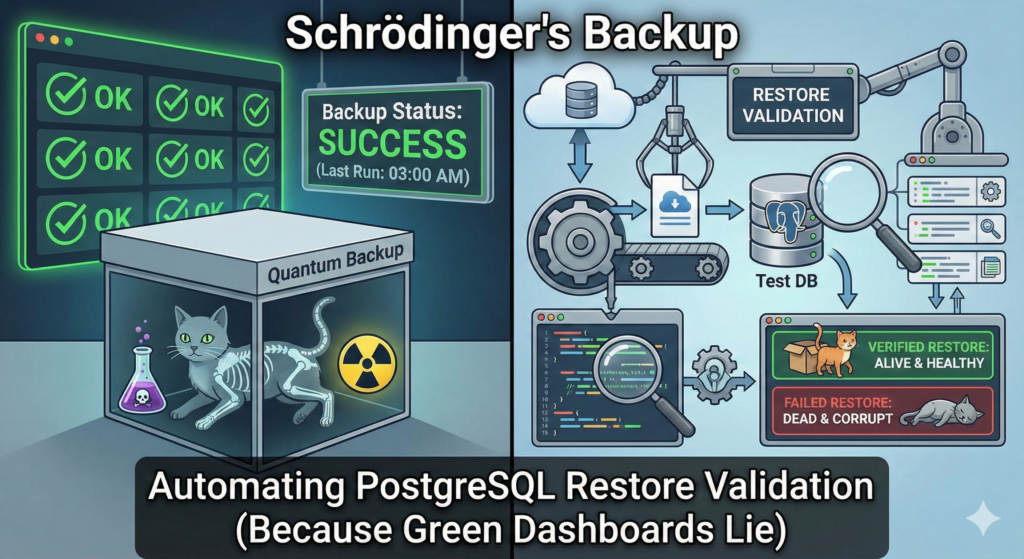
pg_combinebackupin link mode to create synthetic full backups for easier restore points. - Store backup chains on reliable, redundant storage and regularly test restores in a staging environment.
By combining these techniques, teams can achieve shorter backup windows, better RPO/RTO, and lower storage costs without abandoning the familiar PostgreSQL ecosystem.
Summary of PostgreSQL Backup Evolution
To highlight the progression from older versions to the newest releases, consider the following high-level comparison.
| Feature | PostgreSQL 16 and Older | PostgreSQL 17 | PostgreSQL 18 |
|---|---|---|---|
| Native incremental backups | Not available | Available via pg_basebackup | Available and further optimized |
| Restore tooling | Full restore + WAL replay | pg_combinebackup (copy-based) | pg_combinebackup with link/clone capability |
| Backup performance | Full only, slower on large data | Faster due to incrementals | Faster with incrementals + AIO improvements |
| Storage efficiency | Multiple full copies | Reduced storage via changed blocks only | Even better via synthetic fulls and linking |
| Complexity of backup pipeline | Often requires third-party tools | Simplified with builtin features | Simplified, high-performance native solution |
Final Recommendations for DBAs and DevOps Teams
If your organization is still relying exclusively on full backups or on complex scripts around external tools, PostgreSQL 17 and 18 provide a strong incentive to modernize. Native incremental backups, synthetic fulls via pg_combinebackup, and asynchronous I/O create a powerful foundation for resilient, scalable backup strategies.
Start by testing PostgreSQL incremental backups in a non-production environment, validate restore procedures with pg_combinebackup, and measure how much your backup windows and storage usage improve. Once the process is comfortable and repeatable, roll it into your production PostgreSQL backup strategy for long-term reliability.